
Intellectually Rich, Emotionally Devastating.
 Follow ILT on twitter @iltfilm
Follow ILT on Letterboxd
A Paweł Pawlikowski picture just hits differently. Especially when it stitches itself to that richest of tapestries: Pawlikowski’s exploration of post-war Europe. Marking the final entry in his trilogy on the period, following Ida (2013) and Cold War (2018), Fatherland grapples with the unsettling scenario of being celebrated by one’s country, despite loathing every aspect of its recent existence. Novelist and social critic Thomas Mann (Hanns Zischler) is the subject in question, as he returns to Germany with his daughter Erika (Sandra Hüller) in 1949, after sixteen years in exile, to receive the Goethe Prize twice over, first in the West and then the East. The result is a deeply moving examination of guilt, identity, and the uneasy relationship between a nation, its ideology, and its people.
As with his previous post-war entries, Pawlikowski demonstrates a remarkable ability to convey so much with seemingly so little, all without holding his audience’s hand. The emerging ideological tug-of-war between the United States and the Soviet Union forms the backdrop to a story that is less concerned with the powers doing the pulling than with the rope itself: Germany, now divided, with its people caught between two radically different visions for its future. Thomas Mann becomes a fascinating conduit through which to explore these forces, his own internal conflicts reflecting those of a country struggling to confront its catastrophic past. The film trusts its audience to engage with this complexity, never sacrificing its intellectual ambition for the sake of easy exposition, all while maintaining an emotional core that lies dormant at first before breaching the surface with undeniable power by the closing shot.
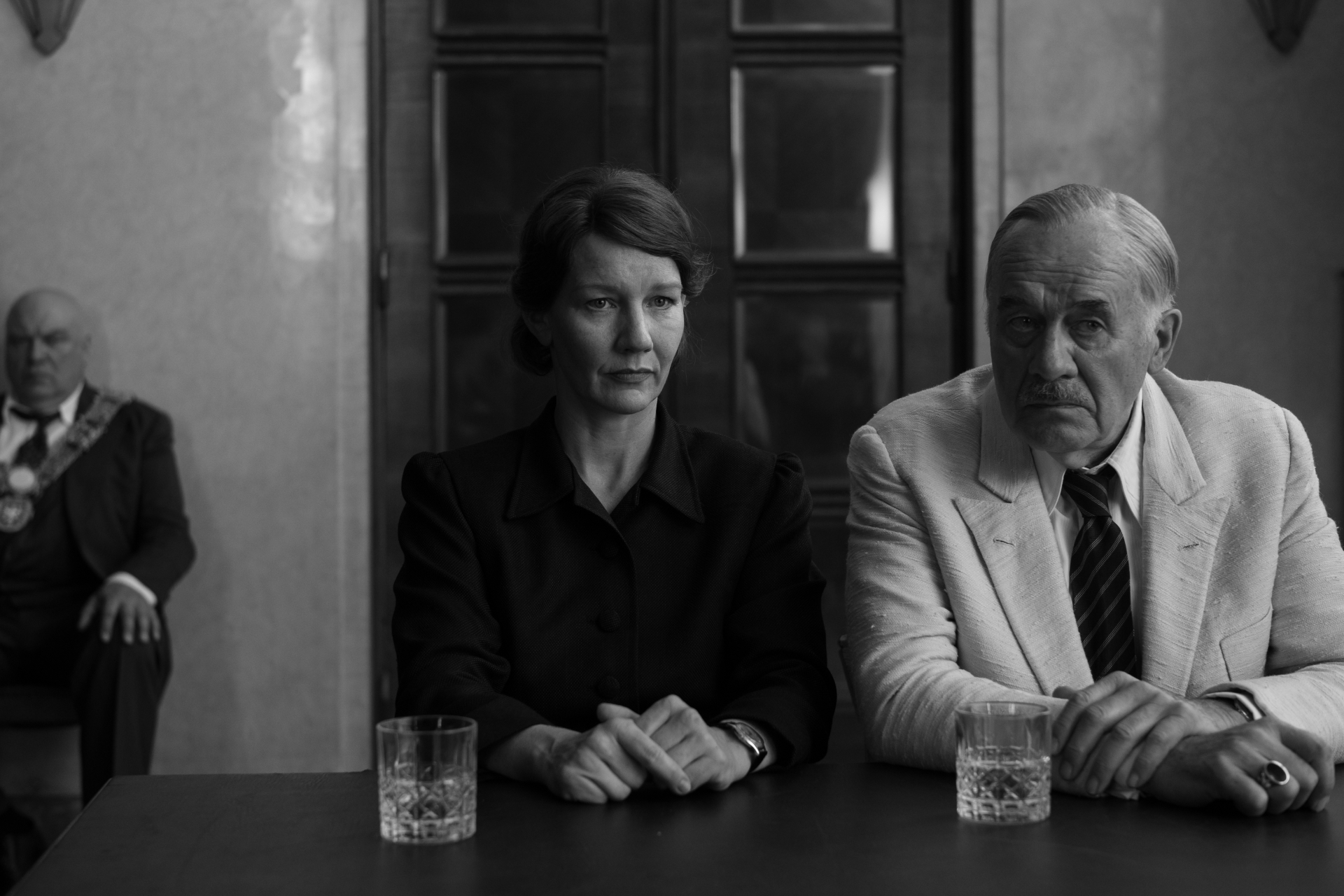
We may be 77 years removed from the events Thomas and Erika Mann are depicted as dealing with here, but considering the state of the world today, it is depressingly delightful to spend time with two people who share such contempt for fascism. Zischler brings a quiet, almost weary dignity to Mann, a man torn between his cultural attachment to Germany and his revulsion at what it had become. Hüller, meanwhile, is outstanding as his protective daughter, whose outward hostility towards those associated with the Nazi regime provides some of the film’s rare, beautifully cutting moments of humour. Clouding their relationship is the presence of Klaus Mann, Thomas’s son and Erika’s brother, played with an aching vulnerability by August Diehl, whose presence lingers throughout in Hüller’s tormented Erika. This has been a prolific year for Hüller, and of the four films she has appeared in so far, it is difficult to look past Fatherland as her understated crowning achievement.
Elevating the picture into the subtlest of stratospheres is the filmmaking itself. Pawlikowski and his frequent collaborator, cinematographer Łukasz Żal (who must be in with a shout for his first Academy Award), are an unmatched partnership in modern cinema. Żal’s gorgeous black-and-white photography, Pawlikowski’s preference for real locations over constructed soundstages, and the meticulous attention to period detail combine to create something approaching visually immersive perfection. Every composition feels considered and every close-up purposeful, with the camera capturing the smallest emotional shifts in performances that are themselves exercises in restraint.
Clocking in at under 90 minutes, Fatherland achieves more than many films twice its length. It is a masterpiece of historical filmmaking, intellectually rich without ever feeling inaccessible, and emotionally devastating without resorting to sentimentality. That Pawlikowski can make such a complex examination of 20th-century European history feel so effortless and absorbing, while remaining so profoundly human, is a testament to a filmmaker operating at the very top of his game.
Fatherland screened at VIFF 2026 It will be released in cinemas on 30th October.
This interview was originally published on FilmHounds.co.uk

