
Actor-turned-writer-director Mayumi Yoshida (The Man in the High Castle) wants to know what love is in Akashi, her gorgeous feature debut shot in Tokyo.
As the film plays at VIFF 2025, Mayumi spoke to ILT about taking a script from the stage to the big screen, shooting in black and white on freezing Tokyo nights, and exploring why generation after generation struggles with the idea of love.
 Follow ILT on twitter @iltfilm
Follow ILT on Letterboxd
Nick Lay: What was the inspiration for Akashi, did it come from your own life?
Mayumi Yoshida: I think the word people are using today is “autofictional”, which I hadn’t heard of, but makes a lot sense for Akashi. The film is based on a conversation I had with my grandmother 14 years ago. I turned that into a play in 2016, then a short film, and now a feature. That original conversation with my grandmother really sparked the fire in me and raised the question of the contrast between the passion of that generation versus ours and how the shape of love has changed. It also highlighted the same struggles and dilemmas we encounter, meaning that plenty has not changed. I wanted to do something with that idea, which led to the play. I wasn’t initially intending to make a feature, even after I had made the short, but overtime the idea evolved and I wanted to tell my grandmother’s story on screen and really do it justice.
NL: The script interweaves, twists and turns, and never lets the audience settle. What was it like transitioning the script from stage to the big screen?
MY: The idea of writing a feature was daunting to me and I owe it to my friends and collaborators who were willing to read a vomit draft, do a table read, and workshop with me. I decided to use the play as the blueprint for the film, but it’s a totally different medium, so I had a lot of editing to do to adapt the theatre script to a screenplay. I expanded scenes and removed characters, but a lot of pieces remained and we magnified the core elements of the story. The biggest difference between the play and the film was that my character, Kana, was a very different character in the play who doesn’t go back to Japan at all. We see her artistic struggles in Vancouver and we stay with her the whole time. She has a relationship in Vancouver in the play and we don’t meet Hiro at all – he’s a brand new character for the feature who grew out of the parallel relationship between the [Grandma’s] love affair and Kana’s own life, and I realised she needed somebody in Japan. I had an outline of Hiro at first, but then when I was doing my vomit draft, he just kept talking and took things in a whole new direction, which I liked.
NL: What inspired you to shoot the film in black and white?
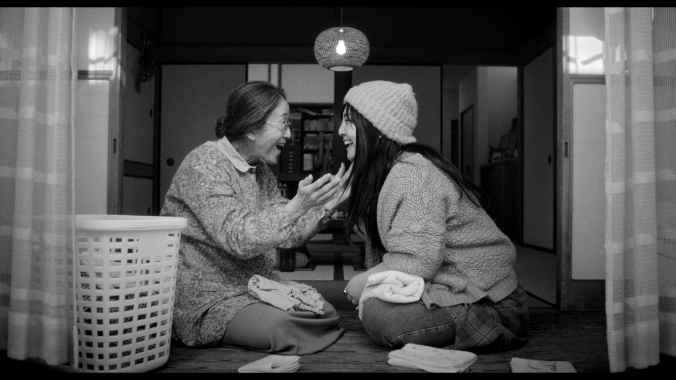
MY: I did not initially plan for the movie to be in black and white, but early on in the process, when I had a first draft, I was inspired to do something different. That was in 2018, which was the year The Farwell came out. Crazy Rich Asians had also come out in 2017, then Minari came afterwards, so there was this wave of films by our diaspora, which was really cool and inspiring. Those films helped the movement of foreign language films being seen as American or Canadian. The language conversation was very prevalent at the time and I realised that my film was in a similar category, but I wanted to tell my story in a unique way that made it distinct from those other films. I started to lean into the playfulness of theatre, because you can bend a lot of rules, which was also something I had seen in the Japanese cinema I had watched growing up. I wanted to explore the idea of what I could do visually to express the difference between the three different timelines and their respective love affairs. I felt a visual distinction would really help, but rather than do it the normal way and have the past in black and white and the present in colour, I wanted to shake things up. If the present timeline was black and white, I could get that timeless feeling for Kana’s journey, because the struggles she encounters are universal but I still wanted them to standout. Every generation goes through the trouble of belonging and feeling lost, and I wanted to remove any judgement and see the Grandpa’s memories through his lens, because his view of the past would have been vivid and beautiful. If we see things through his lens, would this relationship still feel taboo? Would we feel that it was the wrong thing to do or would we root for them? That was the question I wanted to raise by using colour the way I did.
NL: You mentioned your love of Japanese cinema – was there a particular influence it had on Akashi?
MY: One of the biggest influences is The Yellow Handkerchief (1977), which inspired the yellow handkerchief prop we have in our film. There’s many things in the film that age with the flashbacks and stay with the family in their world, and the handkerchief is passed down from the very first scene to the very last shot of the film. There was an alternate ending that we couldn’t pull off because of the location and budget, but the final airport scene was originally written a little differently and the yellow handkerchief played a big role in helping Kana and Hiro come together in the end.
NL: You put together an outstanding cast for the film. What was that process like and what was it like working with Hana Kino, who plays the grandma?
MY: My cast was phenomenal and I knew that it would make the film shine. I started out as an actor and I still love working with them, so I was meticulous in making sure we cast the right people and we had incredible casting directors in both Japan and Canada. Everyone was down to rehearse and we did it like a play at first, which really helped me to figure things out. Hana Kino is a legendary actress in Japan who has been in countless films, has worked with many great directors, and is a theatre director herself. She plays gentle characters like this but also loves eccentric roles, like really crazy performances, so she is very versatile. We looked at the grandma character first, as she’s such a huge part of the movie and we wanted to build the world around her. Hana-san actually kind of looks like my grandma, and when my mum and other grandma were here to watch the movie, they both said how much she reminded them of her. She’s also just a great actress and the funny thing was that she did not relate to my grandma’s character at all. She loved the role, but is a modern woman and said that if anyone had cheated on her, then she would have left them!
NL: The Tokyo rooftop scene combines stunning imagery with the brutal reality of love and modern relationships. How did that scene develop? Was it the hardest piece to shoot or does another sequence stand out?
MY: I love that scene and it was one of last big scenes we shot in Japan. It was very emotional as it really felt like we had done it, but it was also so cold! There was wind blowing and it was freezing – I had heat packs all over my body! Ryo-san (Ryo Tajima; Hiro) and I rehearsed so much and actually went out to places like the shopping arcade and snack bars together, literally as our characters, to build their histories. The gentleman patrons in the bar were like, “Why can’t you be together! Why do you have to go to Vancouver!”. We completely fooled them, which was great. We had a lot of time to build everything together but knew we didn’t have a lot of time to do the scene, so we just went out and enjoyed it. I was so lucky to have an actor who was down for everything I wanted to do.
One of the most challenging things that we filmed were the phone call scenes between the old lovers, as we only had 40 minutes to shoot each scene. It was always scheduled at the end of the day and kudos to the actors as they were phenomenal and nailed it every time, despite only having two or three takes. That scene was a very emotional moment for them and they were able to lock in and get it done, even with all the chaos around them.
NL: The theme of how hard it is for the right people to be together through generations features prominently, as does the evolution of love over time. What was it about these elements of love that spoke to you?
MY: The way my grandma looked at love was shocking to me because she never really knew what it meant. She was in an arranged marriage and thought that she should not stop her husband from connecting with the love of his life, who he couldn’t be with due to circumstances beyond his control. That made me think about why is it seemingly so difficult for our generation to just say “yes”, versus this woman who doesn’t know what love means but is able to commit to it in her own way. I wanted to portray these yearning relationships across generations while showing that both generations think the other one has it better. In reality, we’re making similar choices and going through similar struggles, but it seems to be harder for my generation to commit to love. After seeing this movie, I hope that people will feel less scared about saying yes to falling in love, loving themselves, or expressing love to their family and friends. In modern times, we’re scared to give it away, for fear of rejection. The kind of love the grandma has is the umbrella, while everyone else gets to experience beautiful pockets of love beneath that umbrella.
NL: Do you have any new projects coming up?
MY: I’m developing a pilot for a new series that’s very early in development and I have a feature idea that’s another love story partially set in Tokyo. I want to keep doing cross-cultural projects as my voice is part of that inbetweener space and I’m excited to explore those themes further.
NL: Are there any films you’re excited for or filmmakers you’d like to shoutout at VIFF ’25?
MY: Kent Donguines’s new one [Treasure of the Rice Terraces] just premiered and it’s such a good film. We’re lucky to be this era where many of us have gotten funding from StoryHive in Canada to make these films. We’ve built a cohort together and each of us now has a film coming out. Last year, our good friend Jerome Yoo made Mongrels and won an award at VIFF – that one is on Crave right now. I’m going to go and see my friend Chandler Levack’s film Mile End Kicks and I’m excited for that one. Natalie Murao, one of the programmers at VIFF, has a short film at the festival that was also shot in Japan. We actually visited their set while they were shooting and it was a carbon copy of Akashi in terms of crew because we recommended the production company and art crew, so it was like being back on our own set!
Akashi played at VIFF 2025 and will be on the festival circuit for the remainder of the year.
This interview was originally published on FilmHounds.co.uk
 In Layman's Terms...
Pingback: ILT’s Top 10 Films of 2025! | In Layman's Terms...